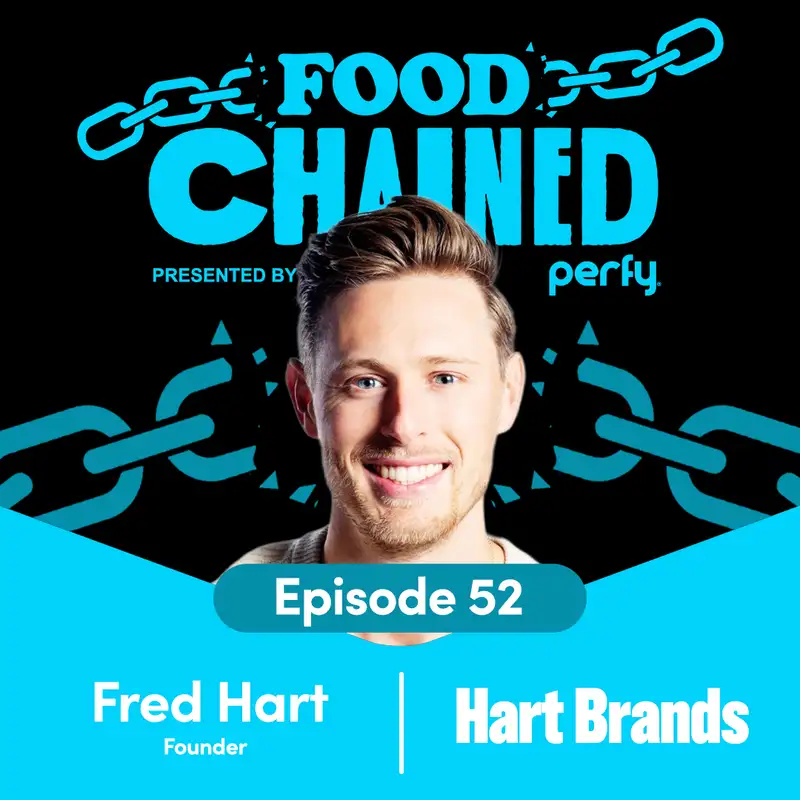
Fred Hart, Founder of Hart Brands
Vasa (00:07.375)
Hey everybody, welcome to another episode of Food Chained. Today we have Fred Hart, the founder of Hart Brands with us today. Welcome to the show, friend.
Fred Hart (00:19.298)
Mom, if you're listening, I love you.
Vasa (00:21.167)
That's awesome. you know anything about me, you know that I love my mom and I miss her every day.
Fred Hart (00:29.442)
Mothers are a blessing.
Vasa (00:31.031)
Yeah, they're awesome. So interesting. The last episode I did with Jed Ross and he ended it with something about my mom. And then the beginning of this episode, you mentioned the mom. So I wasn't quite expecting it. But I did. We had that book ended with the founder of Freestyle Snack. So exciting stuff. I'm excited to chat about creative and less more things that make me sad. So anyway.
Fred Hart (00:42.286)
Yeah.
Fred Hart (00:59.032)
Hahaha.
Vasa (01:00.335)
I noticed that you have quite the experience. One of my favorite things when I have guests on the podcast is going through their background and seeing how that shaped them into who they are today. For me, Quest, Legendary, all of these cool brands, but before that was the service industry. With yours, you have so much fruitful experience. Walk me through, not as quick as you can, but concisely, your experience and how it led you to heart brands.
Fred Hart (01:17.816)
Mmm.
Fred Hart (01:27.596)
Yeah, you know, I'm born and raised in Hawaii in the middle of nowhere. And I think it gave me a big curiosity and hunger for information and learning things at a young age. You're constantly being visited by people. And so you want to know more about what's in the, what's outside of the rock that you're living on. Design is kind of the career that I've made for myself in CBG. And that all happened through my love of basketball. So growing up, my favorite players all had signature sneakers.
And I started to learn about Jordan and Tinker Hatfield, the architect turned shoe designer that made the most iconic silhouettes. And that was what led me to want to pursue design. I was actually at 13 was sending sketches to Adidas and then they sent me like a MNDA or something. And I got spooked that they were going to steal everything from me. So I stopped sending them stuff, but went to college, studied graphic design, and it was an internship my summer year that changed everything for me. I went and worked for an agency in the Bay area.
that had created Monster Energy Drink. And they were kind of a boutique agency that worked mostly with challenger brands. And I fell in love with CPG and packaging because packaging is the only form of competitive design in retail. It fights for share of stomach, share of occasion, share of moment, share of wallet, and psychology and design play a big role in shifting consumer behavior. And I love that chess match.
Vasa (02:53.935)
Let's take a quick break there. One, what were your favorite shoes? And two, what position did you play in basketball?
Fred Hart (03:02.446)
So I'll start with the position. Growing up in Hawaii, if you're white, you are a minority, which I think is a privileged position to grow up that way. Gives you a lot of respect for other people, but I'm 6'4", so I grew up as a center in high school, which is ridiculous, because then when I went to college, I learned to play point guard and everything. So I'm essentially a guard that knows how to play in the post, which is quite unusual. And favorite sneakers? First shoe I ever waited for.
was at the Honolulu Nike Town, which does not exist anymore. And I got the Jordan 3 flips, where they took the elephant print from the showtel, from the shoe box, excuse me, and the heel, and they flipped it onto the majority of the shoe. But I always loved Kevin Garnett growing up, and he had these tie-dye Nikes. I can't even remember what the model name was, but those left an impression on me as a kid.
Vasa (03:57.519)
big ticket. Mine were definitely the 95 Air Zoom flights, the flight 95s, the Jason kids, and that white, gray, and black. I loved the first few pennies and then the up tempos were awesome, especially the ones that were I think inspired by the Pippins with those little bubbles that kind of look like the flight 95s. But man, when I see these old school, you remember East Bay, right?
Fred Hart (04:06.56)
Yeah, yeah, yeah.
Fred Hart (04:12.142)
Pennies are great.
Fred Hart (04:20.17)
huh. Yep, yep, yep, yep.
Fred Hart (04:26.686)
I had the catalog. was reading that slam double XL like, but the East Bay was I had ankle weights that I bought off East Bay to try to increase my burden back in the day. Yeah. Yeah. Yeah.
Vasa (04:30.03)
Yeah.
Vasa (04:35.757)
My brother had the jump shoes, those clunky white, yeah, he still has them to be honest. Great stuff, it's really cool that, like, I feel like every...
Occupation has its own like video game and with design or with me with marketing everyone has their own style and that style reminds me of like Street Fighter or Cool Borders from back in the day where each character that you chose had their certain strengths and some people shoes some people are inspired by cars some people are inspired by fashion Always exciting. I don't think I spoke to a sneaker head that does design for a living so I'm excited for this episode
So isn't it crazy you went to work for an agency that is known for working with challenger brands and that challenger brand was Monster? Like that's so insane to think that Monster was a challenger brand at some point.
Fred Hart (05:29.134)
Absolutely. Yeah. mean, the craziest part and a lot of people don't know this is there was a natural soda company out there that still exists, mostly West Coast distribution called Hanson's. And Hanson's soda actually gave birth to Monster Energy. They had a natural energy drink before the category really even existed called Blue Sky. But Red Bull came in, introduced the concept. Then you had Rockstar and a cup full throttle from Pepsi and NOS and all these brands. I think Monster was introduced 10 years
Vasa (05:38.297)
Mm-hmm.
Fred Hart (05:58.51)
after Red Bull was founded in the States. the case study that I got from Ian McLean and the people that were there were just, they felt like there was an audience that wasn't being spoken to. And in a lot of ways, it is kind of the old school version of a liquid death in the water category. They went after these people, BMX, alternative sports, very different lifestyle and built something for them where Red Bull was kind of this European imported fueling brand.
really had no connection to the States other than being the first mover and shaker and really creating the category. yeah, it is wild to your point to talk about a billion dollar brand as a challenger. But I learned a lot of great lessons working with that agency at the start of my career.
Vasa (06:44.107)
I think agency work is great. It's not for everybody, especially over the long run, but it is a crash course and learning as much stuff as you possibly can as fast as you possibly can.
Fred Hart (06:56.002)
Yeah, greatest piece of advice I got from my professor in school is make my mistakes on someone else's dime. Being surrounded at an agency by other smart people was a great way to accelerate that.
Vasa (07:01.561)
Yeah.
Vasa (07:07.375)
That and learning from other people's mistakes is my favorite one. There's certain things that I've studied over the course of my career or just learned or observed. I'm like, I'm not gonna do that thing whenever it comes time to do it. I'm not gonna do it. It's definitely important to take with you. So after the design agency, what happened? You spent time at another agency, right?
Fred Hart (07:10.766)
Yeah.
Fred Hart (07:20.706)
Yup. Yup.
Fred Hart (07:27.49)
Yeah. I spent time in another agency that was much more of like a larger global strategic works with like big companies like Johnson and Johnson and scrubbing bubbles and pledge and international delight creamer. And then 10 years ago, moved to Boulder, Colorado, where I live now and, joined a former business partner and kickstarted an agency called interact. And we grew that from three people to 30 over nine years. We started working with mostly.
entrepreneurial brands. worked with Koya in the plant-based beverage space. were raw nature five at the time. Five organic, which got acquired by Suja, which is two ounce cold pressed juice shots. Kettle and Fire, one of the largest bone broth companies. And we had this great sort of batting average early on with entrepreneurs and then started working with growth stage companies. Companies, know, maybe 50 to 150 million in revenue that were going through that needed to change, needed to better compete, maybe leaving the safe haven of natural and going.
to compete in conventional and then started working with some of the large strategic. So like I've rebranded Hot Pockets for Nestle or I've worked on Lingkwizine or DiGiorno. I worked with ConAgra and a year and a half ago exited that business and have been independently consulting with clients since for the last year and a half.
Vasa (08:42.031)
Very cool. And do you do branding projects of your own now, or do you consult with their branding agencies?
Fred Hart (08:48.55)
A bit of both. That's the nice thing that I like. I'm really trying to reinvent the agency model, which I think is a little bit broken. So I use what I call an open source forum. So on project work, I basically build teams. I assemble a Marvel universe based on people's backgrounds, skill sets, the clients need what we're trying to build and go and do that. And then other times I have the flexibility where maybe I'm plugging into an eternal creative team at a larger company and bringing perspective and ideas.
And then sometimes I'm just helping founders, you know, create brand strategy and naming from scratch, and then identifying very cost-efficient freelance partners and maybe doing a little fractional creative direction. I'm just in the, I'm in this, this world of just providing value where I can with people that I want to work with.
Vasa (09:38.447)
I learned a tough lesson when you mentioned that you guys grew from three to thirty in nine years. I went from one to like thirteen and three or four years and it was not the right decision. You know, I love a lot of the folks that we worked with but what I realized the most is the more Growth Buster made, the more or the less I made. And I miss kind of like those early days similar to what you do. I had a select group of people that I worked with and brought on the projects and
Fred Hart (09:50.829)
Mmm.
Vasa (10:07.981)
I was making the most I think I had ever made in my life. And I was like, what do I do with this? I just left West Nutrition as like a senior marketing manager there. didn't make a ton, you know? And I was working at another place as director of marketing and then I went on to Legendary and Legendary Foods.
Fred Hart (10:21.389)
Yep.
Vasa (10:23.669)
Ron Penna, this is just a random story about me. I actually was gonna leave Quest Nutrition early on and Ron was like, what are you doing? Why do wanna leave? We like you. And I was like, well, man, I just left the nightlife industry where I was making four times what I'm gonna make. can't pencil things out. And he walked into a room and next thing you know, like they nearly doubled my salary and I'll never forget that. And I owe him to this day in that regard. But I went to Legendary after I left Quest and had a quick stay somewhere else.
Fred Hart (10:28.619)
Mmm.
Vasa (10:52.417)
and he brought me on and he let me build Growth Buster on the side. So there was a time period where like it was very, very fruitful. It was awesome. The day that I left Legendary to pay myself full time at Growth Buster was one of the coolest moments I think in my career because it's a huge step. People don't really like the idea of betting on themselves, but man, I thrive off of it.
Fred Hart (10:56.494)
That's awesome.
Fred Hart (11:11.374)
Yeah, I totally agree. I that was why I left the San Francisco firms and went to Boulder at the age of 27 to become a partner and creative director in a business. had no, nothing that I'd done had prepared me for that, but I just knew it's a rare opportunity to bet on yourself and to have that privilege of control. And I'm really loving that today. I'm, you know, I've got to.
two and a half year old daughter and my priorities in life have shifted and I want to work hard but I also want to be with family and this allows me to do both in a really wonderful way.
Vasa (11:46.329)
that's the right place to be. I don't have children yet, but I have dog children. if I can't focus on them on a walk, like, I'll pull up my phone once in a while, but if I'm on my phone the whole time while walking with my fiance, I feel like, what if I'm doing this when I have human children? I'm not a dad, and I think parenting dogs is a good practice for that and finding that balance.
Fred Hart (11:51.969)
Hahaha.
Fred Hart (12:05.538)
Yeah.
Fred Hart (12:10.006)
Yeah, I skipped the dog phase and people ask me if I have pets. like, yeah, I got a two-year-old daughter.
Vasa (12:15.343)
Yep, fair enough. So you travel a lot right now to, or relatively a lot. You go to a lot of these really cool events. were just at CHFA. You I think, at Utopia now. You go to these events and you do recaps and notes on design. Tell me more about that. And then also let me know some of the things that excite you out there.
Fred Hart (12:34.786)
Yeah. I I tend to basically 12 to 15 food beverage trade shows a year. And I do it because I love to learn quite honestly. I'm obsessed with the indigestory. I love the community. I love being around founders and understanding and studying how the industry is shifting from product innovation perspective to consumer trends, to branding and design in general. And yeah, I do a lot of recaps because I also believe in sharing the things that I'm privileged to see and participate in.
take part in. CHFA was cool. I was like two weeks ago in Toronto. They have the winter show or the kind of fall show in Toronto. And then the other half of the year it's in Vancouver. And it's nice to be able to look at, you know, our neighbors up north and how it runs in parallel to what we're seeing in the States and then where it varies and is different. And it's a smaller format show, but really rewarding and a lot of innovation that I would not have expected otherwise.
Vasa (13:29.999)
What are some of the, what's that like pinnacle of the year in terms of brands and design? Is it Expo West for you?
Fred Hart (13:41.556)
No, I think Expo West is overhyped. Don't get me wrong, it's a lot and it's magic and it's four days of just overstimulation of conversations and seeing things. But there's a lot of great sleeper shows out there that I think are as valuable, if not more valuable for someone like me. I mean, I go to these shows so that I can understand my clients' worlds and speak their language better. It helps me be a better creative by showing up.
When I go to the private label manufacturer show or supply side West and understand the supplements side of things, or go to super zoom, go understand the pet industry. I walk away with an expanded understanding of more data points to start connecting. that ultimately gives me an information advantage. Expo West is great, but it's so noisy that I think people have a disconnect from reality that like this echo chambers all in one place.
That is not, walk into a grocery store in Des Moines,
I do a lot of personal travel and every time I do, I always do store checks and I see what's going on and what innovation looks like. Expo West is both the best parts of our industry and the worst parts of our industry.
Vasa (14:53.027)
Yeah, hearing some conversations sometimes is quite awkward. I once I wanted to do a bingo card of like sayings that you'll hear like overheard Expo West type stuff like, did you hear so and so raised this amount of money? like, it can be a little unfun in certain ways, but very cool to meet certain buyers. I personally looked at the layout floor plan for next year.
Fred Hart (15:01.546)
Hahaha
Fred Hart (15:07.458)
Yeah, yeah, yeah.
Fred Hart (15:20.27)
Mm-hmm.
Vasa (15:20.531)
And I was surprised, and I don't know, I've never looked at it this early, but it feels a little bit light going into next year. And I think they've already been reaching out for people that they've noticed haven't signed up to sign up. And I'm wondering if it's starting to catch up to them. Because buyers are going in, their windows are just so much shorter. I think a buyer goes for one day and they beat it. And I think that's not helpful.
Fred Hart (15:28.59)
Thank
Fred Hart (15:45.422)
Yeah. mean, the shows exist for buyers, right? Like I'm on the service side of the spectrum, which is why I focus on writing about things and highlighting brands and trends because that's so much more valuable to the ecosystem than trying to find new business. The industry does not need that. The industry needs the retailers to connect to the brands and that's the real focus. And kudos to Informa and New Hope that runs Expo West. The Utopia Now trade show is doing a great job at making space.
and being much more affordable. think this new topia went to roughly 45 % of all brands were first time exhibitors. It tells you there's a very healthy upstart ecosystem that that show caters to. And I think that's necessary as a bookend to Expo West, which is getting more and more expensive and it's all the big brands schlepping out their incremental innovation.
Vasa (16:36.291)
Yeah, I can't speak to Newtopia now. It seems exciting. It seems like it's growing for sure. Expo West on the other hand, just, sometimes you go and you spend all of these thousands and I'm really good at being cheap at Expo West. Like I'll never ship into the, what are they called? The union again. It's like three dollars and change per pound.
Fred Hart (16:47.31)
You
Fred Hart (16:51.816)
yeah. Yeah.
Vasa (16:57.609)
and I got smoked at one of the broad line shows in Chicago one time and I'm like, dude, this is a half pallet and that cost me three grand. So I just, I ship my stuff to my hotel or if it's XOS, I'll drive from my house and Torrance and commute in my SUV. I got an SUV specifically for these types of things and I keep it as cheap as possible.
Fred Hart (17:13.496)
There you go.
Smart, smart, very smart.
Vasa (17:19.695)
What are some design trends that you think, well let me frame it this way, what are some design trends that you're excited about and what are some things that you think might be a little bit tired?
Fred Hart (17:33.026)
think the Gen Z aesthetic is over-stereotype. The stereotype is massive on it and it's colorful and big type and big personality, but Liquid Death caters to a lot of Gen Z. That is totally not what you think of that norm. Brands that challenge the category in terms of design semiotic codes without challenges in the consumer, think are really fun and exciting. I love what David Barr did recently.
You look at the bar industry and everyone's like all big product imagery and this over promise of it's going to taste like a donut or like a cinnamon roll. And they're much more lifestyle. And they're not also not shouting at you like their protein content, like everyone in the category is right now. So there's a sense of restraint and originality and sharpness that works for their intended audience. think brands that understand their audiences and design for them are always the ones that are the best.
But in general, I would say there's a resurgence in characters right now that's pretty fun. Characters used to be reserved mostly for the cereal box moment. And now you're seeing them pop up in olive oil with graza or on pickles or pasta or crackers for Passover from men's shavets. There is a light hardness that has always existed in the UK or in places like Japan that I think is coming to the States, bringing some real freshness to the industry as a whole.
Vasa (19:02.199)
Yeah, I agree with a lot of that and you very well put. I feel like Magic Spoon, and this is a total Homer talk right now, like yes, we worked with them, but.
I think they're my first observation of bringing that cartoony aesthetic back to branding. think that they get a lot of hate on the marketing Twitter or DTC Twitter. I don't know why, but I feel like they are pioneers. In my opinion, there was Quest Nutrition, there was Halo Top. Halo Top, I think, revolutionized the way people did social with stills before it was vertical video shorts. Then I think Magic Spoon was that next evolution of like...
Fred Hart (19:34.392)
Mm-hmm, mm-hmm, mm-hmm.
Vasa (19:40.663)
how to look on social, yes we did that. I think that what we did early on, when I look back at 2019, like holy shit, things have evolved so much, like this is terrible. But I think that they brought a lot of the cartoony type stuff back in a way that was approachable and more for like adults.
Fred Hart (19:56.876)
Yeah, you know, they're bringing modern nostalgia, in a really frustrating way. And it helps that they started with cereal, right. As that entry point. And now they've got this pipeline of innovation and what Gad and Greg are doing, you know, their seasons, CPG vets, and they understand the power of brands. But, I would, I would full heartedly agree with you. And I think you're also seeing a lot more of like emotive design. Like if you look at the NA space or in kind of supplements, you're getting away from being.
really tactical and functional, like the organs of the world, all about claims and product benefits. And you've, you've seen these like really cool companies just like come in, like, I mean, look at like happy Viking in the protein space or seek like colors and playbooks that have worked in other categories are now disruptive within supplements, is predominantly masculine, aggressive, performance oriented, black, large italic type. now there's a new breadth and
generational design language being spoken in that category. oftentimes design is all about the strategy of borrowing something from one place and placing it into another. Like if you look at saws in the tomato sauce category, tomato sauce has always felt imported, elevated type, gold. Saws is coming in and basically taking the poppy playbook and it's working beautifully for them. And it's fun and it's cool and it's disruptive and it's flexible. And I love, I love to see companies like that doing things differently.
Vasa (21:25.537)
a good way to put it and there is a common thread there because Kavu backed Poppy and now they're backing Sauce.
Fred Hart (21:29.934)
Yeah. And Cavu is great. know, Cavu is one of those VCs that have internal creative in-house. It's a part of their value proposition when they work with clients. And I've known a couple of the creative directors that have been there and they always do a phenomenal job. basically have an in-house agency.
Vasa (21:50.927)
That's awesome. That's a dream there. And you said, what was your answer for what's a little bit tired out there, the Gen Z aesthetic?
Fred Hart (21:59.424)
I just like the assumption of like that you can just kind of slap some aesthetic styles over something that will work. think that again, it depends on the category context and the codes of a given space. actually think for instance, I mean, in your category, it's crazy. The amount of, you know, better for you. So does like still are just launched. got slice, you got all these every day. There's somebody coming in.
kind of everyone's replicating the same playbook. think that initially the Ollipops, the poppies, you guys have been around for long enough, like the color coding systems and the fun really work, but like now everyone gets lost in it because everyone is replicating the same playbook. I'm about to write about this on LinkedIn, but if you look at Zivia, the OG of like zero calorie, you know, naturally sweetened soda.
They have two limited edition products on their website right now. And there are hints at the redesign that they're just about to do. And they redesigned in 2021 or 2022, I think. They're going to brand block across the top and have some consistency, which is going to work in a world where everything is, you know, the rainbow factor, the Skittles approach. And that's the kind of thinking that I think like certain categories need more of is like, what are the design mechanics? And if everyone's doing a different color per can.
You actually stand out by doing the opposite and taking the big brand playbook.
Vasa (23:30.159)
Yeah, I have plenty of thoughts on this. went to the, I usually don't talk about Perfume. I'm gonna go for a minute here. So first and foremost, I think everyone is doing the exact same thing. And I think there's brands literally taking the architecture of a front of pack of can and just putting their own thing. We see it everywhere. I'm not gonna name drop anything, but you know when you know.
Fred Hart (23:34.593)
Yeah.
Do it.
Fred Hart (23:47.874)
Yep. Yeah, yeah, yeah, yeah, yeah.
Vasa (23:51.535)
I think that a lot of brands have, I actually got declined by a retailer because they said everyone, you look the same as everyone else. I said bet. So I went to the Quest Playbook and I did real fruit on the front of can. And if you, there was, I literally have a picture as proof of Mother's Market in Costa Mesa. And I took a picture.
Fred Hart (23:57.814)
Yeah.
Fred Hart (24:08.046)
Mm-hmm.
Vasa (24:08.801)
I actually know this was when it was in Manhattan before Arowan replaced it. And I took a picture, was like, holy smokes. Every single canned item, doesn't need to be better for you soda, but every single canned item in this picture has illustrated fruit. Perfie's main thing, like Foxtrot said it, Perfie tastes as though it was freshly picked from a tree early on. And that's when I was like, I have to put real fruit on here. it bothers me sometimes, I saw the hints of...
Fred Hart (24:22.019)
Yeah.
Fred Hart (24:31.554)
Yeah, that's your story to tell.
Vasa (24:37.643)
of Zivia's rebrand again. I, what they're doing is illegal. It's like, cause their natural flavors are likely derived from the fruit that they're depicting with the real picture. Not hating on that. But what I do like to say is, man, if we go back in time, there's very few brands that did that. It's exciting to see more of them. But I think that there's one needs to be more real fruit, but it needs to be justified. Either the natural flavors are organic and derived from that fruit.
Fred Hart (24:49.538)
There we go.
Vasa (25:05.647)
or something in nature. then, what's the second? Or they just need to use juice, like real juice. that's, the other part is agreed on the Skittles effect. That was something we did back at Quest back in the day.
Fred Hart (25:12.343)
Right, right, right, right.
Vasa (25:19.951)
And that was like a new kind of, we're gonna do this and we're gonna brand block around all of these colors and this is what it looks like. They built a GNC in the back in the studio. That was groundbreaking back then. And I have a mock-up of what Perfie would look like if all of the cans were white and the fruit pops out with gloss while the white's kind of a matte.
Fred Hart (25:21.729)
Right?
Fred Hart (25:36.216)
I'm sorry, I'm sorry, I'm sorry.
Vasa (25:38.177)
And I almost want to do that sooner than later. There's a one where it's black. Like when we launch our our cola version, I might go black or silver to depict kind of popular colas out there. But the white looked really good and it popped out on the shelf. And there's other brands doing that too. But I see what Ziva is doing. That new CEO from Red Bull.
Fred Hart (25:44.44)
Yeah.
Vasa (25:59.279)
She's so badass, man. She just came in and did such a huge lift on making them so cool again. And they're one of the OGs. Early on, they remind me of Springfield. Springfield sodas, though. Springfield used to have these little soda droplets on the side of the cans. They don't exist anymore, but Springfield, like, they were sold at a place called McCowen's when I was a kid, and that was like the best soda. It was all fruity. They used the Skittles effect, but they had little bubbles on the side of the can.
Fred Hart (26:12.302)
Ugh.
Fred Hart (26:25.61)
Yeah, yeah, yeah, yeah. And they kind of had a pattern that created some continuity across the entire line of that's cool.
Vasa (26:31.991)
And their logo looks like freaking Hormel. I remember. It's pretty funny.
Fred Hart (26:34.944)
Yeah, yeah. That throwback style is coming back in now. We're gonna come full circle and small brands are gonna wanna look like big old brands and that's gonna be the next wave.
Vasa (26:41.741)
Yeah, Steelers?
Vasa (26:49.135)
Yeah, I like the callback to nostalgia. think it's important to balance it though, because if you go too heavy, like, it could be too much in my opinion. And some of the social media managers are 20, 21, they weren't even born back when, but yeah. Yeah, so there's a fine balance, I think.
Fred Hart (27:05.1)
Yeah, they don't know. It's just new to them, not nostalgic.
Fred Hart (27:11.554)
Yeah, for sure.
Vasa (27:14.303)
All right, got, I think, time for one solid question. think this is, you can take this one, you can pass on it if you want, but if you were to do a power rankings of branding agencies in the United States, what would your power rankings be? It doesn't need to be in order. We don't want to PO anybody, but if you can name your top five, who would they be for you?
Fred Hart (27:34.412)
Yeah, well, I have that answer, but I'll give you a caveat first, which is it depends on what you want. So I've been hired recently as like a fractional creative director with a large CPG company to help them craft some briefs. And they have two different product lines that need to be redesigned. One of them needed more revolutionary restart. And the other one was the moneymaker and needed evolution. I was a part of helping them understand which agency should they talk to because I come from that world and I know a lot of the owners and.
For the revolutionary stuff, you want a very different set of agencies than you do when you want to maintain some continuity or recognition with a preexisting business that has product market fit. So it just depends. I think right now, agencies that are super hot are the ones that are reinventing the playbook and building the next wave of disruptive brands. So Gander in New York, you go on their website, they did Bonza, they did Graza. They've done all of these awesome companies. Center by Alex Center is a good buddy.
He's built a bunch of great brands. United Soda of America, think was one of them. One of those butter. He just came out with a male sperm fertility brand called Swim Club. Fucking great. Wedge out of Toronto or Montreal. They do phenomenal work. Dayjob out of Los Angeles. They're the ones that are doing like David and Fly by Jing and all of these crazy different brands.
Vasa (28:38.617)
Mm-hmm.
Vasa (28:45.742)
Mm.
Fred Hart (29:01.512)
I love to look at and study those companies. I don't believe in being as progressive as some of them. I really love kind of like taking brands that are working and just making them work even harder. don't, but, but it's always good to study people that really push the creative envelopes on the other side of the equation. have like. Pro Fisher, Turner Duckworth, JKR is unignorable, right? They're doing all of the big rebrands for Burger King and Budweiser.
and all these companies. got a buddy called Mike Perry who runs a company called Tavern. They did the rebrand of Sizzler, really stellar work. And so again, two very different sides of the equation, but those are some of my name drops.
Vasa (29:36.591)
Mm.
Vasa (29:45.359)
That's amazing. Speaking of Sizzler, one, that's like so retro nostalgic. That was like the place to go back. That's where we went every time we graduated from like elementary school or middle school. I don't think I went there for high school, but I recently saw someone on LinkedIn who works at Sizzler, but there's a backend and name to it that I didn't recognize. Now like Sizzler Smokehouse or something. forget what it was. And I was like, that the same Sizzler? And I clicked into it and then I went to the website. was like, holy smokes, this is the same Sizzler.
Fred Hart (29:48.182)
Hehehe.
Fred Hart (30:04.973)
Mmm.
Vasa (30:14.095)
and I saw the rebrand and I really enjoyed it. It doesn't remind me as much of like the hut and all of that, but nor should it. It was tried and true. Hearing that name with you cracks me up.
Fred Hart (30:22.754)
Yeah, yeah, yeah, yeah. Yep.
Yeah, I so as a, you know, I used to go to those as a kid. would never, can't find me dead in one now, but they're trying to change that persona and design is a big part of changing people's perceptions. Obviously the experience is what matters the most. What's the food like, what's interiors like, et cetera. But it's it's great work that the Tavern Crew did.
Vasa (30:33.987)
Yeah.
Vasa (30:48.247)
When it comes to branding and design, how important is thinking through not just the actual packaging, but how that translates onto a website or onto Amazon for you.
Fred Hart (31:01.506)
mean, it's critical. All brands are omnichannel brands at this point. The DTC only playbook has been disproven. Everyone needs to be in retail and vice versa. I think when it comes to packaging in particular, what works in retail works in DTC, but the opposite is not true. I've worked with so many companies that focus on their online business to start, Dr. Squatch being one of them that I've worked with. And when they finally need to go into retail and compete with Colgate, Palmolive or J &J or...
you know, Unilever and fight for consumers without the benefit of their fun social media and their fun website. Packaging has to hold a lot, but at the end of the day, everything has to be a cohesive thread where every touch point reinforces behavior action. And so that's, think the fun part because you can do so much in the digital worlds that you can't do in a physical world. so yeah, I mean, it is, it is critical, but
Packaging is the number one form of ad spend for a CPG company. It's the most critical consumer touch point. So if that doesn't work, it doesn't matter what else is going on.
Vasa (32:07.193)
Fair enough, that's true. Alright, last one, bonus question. If there was one brand out there that you can work with tomorrow and either evolve their existing brand or create a new one, who would it be?
Fred Hart (32:21.806)
Mmm.
I'm thinking of all of the big legacy brands and...
Oh, it's such a good question. I I could love to work with something like a, a, like Triscuit did a redesign. It's kind of like blah or cheese. It's those that kind of like category comes to mind. Um, but there has to be really be a problem. See, like when you ask me the questions, like, aesthetically, I don't like some of these things, but it still works for their audiences. Pop-Tart actually, let's say Pop-Tart. Pop-Tart is tired and old and you've seen
cool brands like Flings and others, you Legendary's got its Pop-Tart version and it's a behemoth of a brand and I'm sure it prints money, but is it primed for the next wave? When I got to work on Hotpockets, that was one of my dream clients. Like I ate so much of those as a kid and it was always focused on the head of household making the purchase, not the eater, not the 15 year old gamer. So to be able to reinvent that and we did a whole mascot and all this other stuff was really fun.
to be able to revisit part of my childhood and usher the brand into a new digital age where it's doing e-sports sponsorships and showing up at Comic-Con and doing all sorts of interesting activations.
Vasa (33:39.469)
Awesome. Fred, this was one of my favorite, like one of my favorite episodes. No, no, no, like you brought up the soda thing. was like, I'm going in on this one. I'm the guest right now too. No, this was.
Fred Hart (33:43.15)
You're just saying that stop.
Yeah, yeah, yeah, yeah, yeah. We covered shoes, soda, CPG, design.
Vasa (33:55.893)
So awesome, man. I'm very, very grateful that you joined, man.
Fred Hart (33:59.298)
My pleasure. Thanks for having me on, Lhasa. Look forward to seeing you at the next trade show.
Vasa (34:01.155)
You got it. Yes, sir.
Creators and Guests